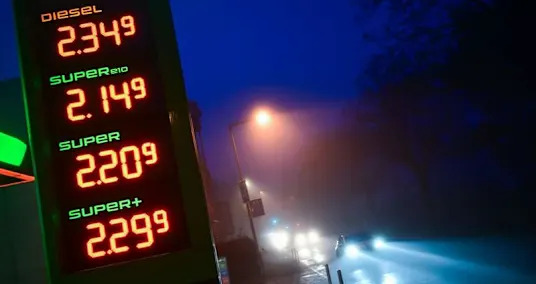
Leading German economic institutes on Wednesday cut their growth forecast for 2026 by more than half to reflect the expected fallout from soaring energy prices caused by the Iran war.
Gross domestic product (GDP) is expected to grow by only 0.6% this year, down from a September forecast of 1.3%, according to figures revealed by five leading think tanks.
The announcement puts another damper on hopes in Berlin for sustained recovery, after the German economy narrowly avoided a third consecutive year of recession in 2025.
The conservative-led administration of Chancellor Friedrich Merz has taken on billions in debt for investments in infrastructure, defence and climate action in a bid to boost growth.
First significant effects of those measures had been expected to make themselves felt this year.
But with the US-Israeli war on Iran expected to severely hamper growth, Germany's governing parties might face further headwinds in upcoming regional elections later this year, when the far right is expected to make major gains.
"The energy price shock triggered by the Iran war is hitting the recovery hard, but at the same time expansionary fiscal policy is bolstering the domestic economy and preventing a stronger slide," Timo Wollmershäuser, senior economist at the Munich-based ifo institute said.
Besides ifo, experts from the German Institute for Economic Research, the Kiel Institute for the World Economy, the Leibniz Institute for Economic Research and the Halle Institute for Economic Research were also involved in the forecast.
The institutes are also more pessimistic regarding growth in 2027, revising their forecast to 0.9% from 1.4% predicted last year.
Inflation expected to rise again
Inflation is also expected to rise sharply and could reach 2.8% on average this year, followed by 2.9% in 2027.
"Although this forecast assumes that energy prices will gradually fall again, they will remain noticeably higher than before the outbreak of the war for a lengthy time, meaning companies will pass on the increased energy costs," ifo said in a statement on the spring forecast.
Surging energy prices due to the Iran war already propelled German inflation to a two-year high in March, with consumer prices climbing 2.7% compared to 1.9% in February, according to preliminary figures released on Monday.
Prior to the war, the institutes had forecast inflation to reach 2% in 2026 and 2.3% in 2027.
The US-Israeli attacks on Iran launched on February 28 have led Iran to effectively block the Strait of Hormuz, a narrow waterway between Iran and Oman that is key for global oil and gas trade.
LATEST POSTS
- 1
 The most effective method to Pick the Right Old Consideration Administration: Key Contemplations
- 2Flu cases spiking this holiday season, CDC data shows
- 3ISS astronaut snaps stunning nighttime photo of Florida and Cuba | Space photo of the day for Dec. 29, 2025
- 4One-third of asylum applications by Iranians approved in Germany
- 5Manual for 6 well known Amusement Park




- When preventable infections turn deadly behind bars | The Excerpt
- German petrol stations hike prices as once-a-day rule takes effect
- 'A perfect storm': Airlines cut flights and increase airfares as jet fuel price spikes
- NASA's Artemis 2 astronauts are cruising to the moon. So why are they doing CPR tests today?
- New India programme supports tribal families hosting tourists
- A Colombian city swaps iconic horse buggies for electric carriages amid animal welfare concerns
- Audits of the Top Science fiction Movies This Year
- Understanding Various Sorts of Financial balances: An Extensive Outline
- Figure out How to Analyze Medical attendant Compensation Patterns Across Different Specializations