When you buy through links on our articles, Future and its syndication partners may earn a commission.

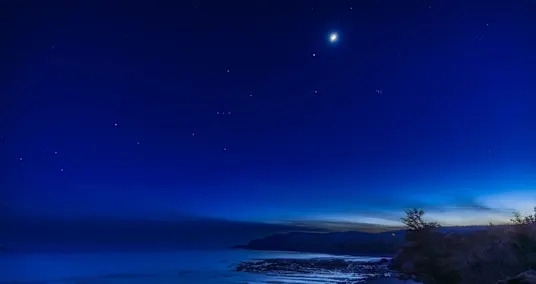
Look to the east at sunset tomorrow (March 26) to see the half-lit form of the waxing gibbous moon shining close to the gas giant Jupiter in the evening sky, as the bright stars of the constellation Gemini twinkle nearby.
The moon will make its closest approach to Jupiter at 9:19 EDT (1319 GMT) on March 26, at which time Jupiter will be lost to sight in the daytime sky. The pair will remain close throughout the evening, however. Viewers in the northern hemisphere will get their best view of the solar system pairing at sunset, when the moon will appear with its right side lit by sunlight high above the southern horizon, less than a day after reaching its first quarter phase.
Jupiter will appear as a steady star-like object glowing brightly 5 degrees to the lower right of the lunar disk — roughly the width of your three middle fingers held at arm's length against the sky. To the upper right shine Castor and Pollux — the bright stars that represent the heads of the celestial twins depicted in the constellation Gemini.
The moon and Jupiter will make for a gorgeous sight through the eyepiece of a 6-inch telescope, which will reveal the dark lunar seas and prominent craters lining the night-day divide on the lunar surface, along with the cloud bands of the gas giant and its most prominent moons.
As the night wears on, the lunar disk will appear to travel away from Jupiter in Earth's sky, before finally disappearing from view below the northwestern horizon shortly after 3 a.m. EDT (0700 GMT) for viewers in New York. Visit Time and Date to discover the exact times that solar system bodies like the planets rise and set from your location.
Jupiter is set to remain a prominent sight in the spring sky until mid-July, when it will become lost into the glow of the setting sun ahead of its solar conjunction on July 29, according to in-the-sky. At that time, Jupiter will be too close to the sun from our perspective on Earth to be visible.
Want to get a closer look at the moon and Jupiter? Then be sure to check out our picks of the best telescopes and binoculars for exploring the night sky. If you're into photography then you may also want to read our picks of the best cameras and lenses for astrophotography, along with our roundups of the finest smart telescopes available in 2026.
Editor's Note: If you would like to share your astrophotography with Space.com's readers, then please send your photo(s), comments, and your name and location to [email protected].
LATEST POSTS
- 1
 The most effective method to Refresh the Infotainment Framework in the Volvo XC40
 - 2Allow Innovative Progressions To have a Massive Effect
- 337 Things Just Individuals Experiencing childhood during the 80s Will Comprehend
- 44 African Vacationer Locations
- 5NASA satellite gazes into Medusa Pool | Space photo of the day for Dec. 24, 2025


- Renewables cover over 50% of German electricity consumption in Q1
- Why home maintenance deserves a spot in the annual health and budget plans
- How AI fixed the James Webb Space Telescope's blurry vision
- Dinosaur collagen used to create one-of-a-kind handbag
- Robyn returns to music with 'Dopamine,' her 1st single in 7 years: 'Came to save music once again'
- Here are 10 stores where you can get a free Thanksgiving turkey
- Step by step instructions to Get the Best Vehicle Rent Arrangement: Insider Tips and Systems
- India's top court hears challenges to ruling on women's entry into temple
- 5 Christmas movies to stream for less with this Paramount+ Black Friday deal